MQC Simulator
An interactive SGPE-model workspace on T(5,2) knot topology: computation worker, array transfer, 3D visualization and metrics.
Wave-field model · React / TypeScript / Web Worker / Three.js / SGPE
The product problem
Let users change model parameters and observe evolution without mixing numerical logic into the DOM interface.
A research browser simulator. Numerical accuracy needs reference cases and time-step/resolution studies.
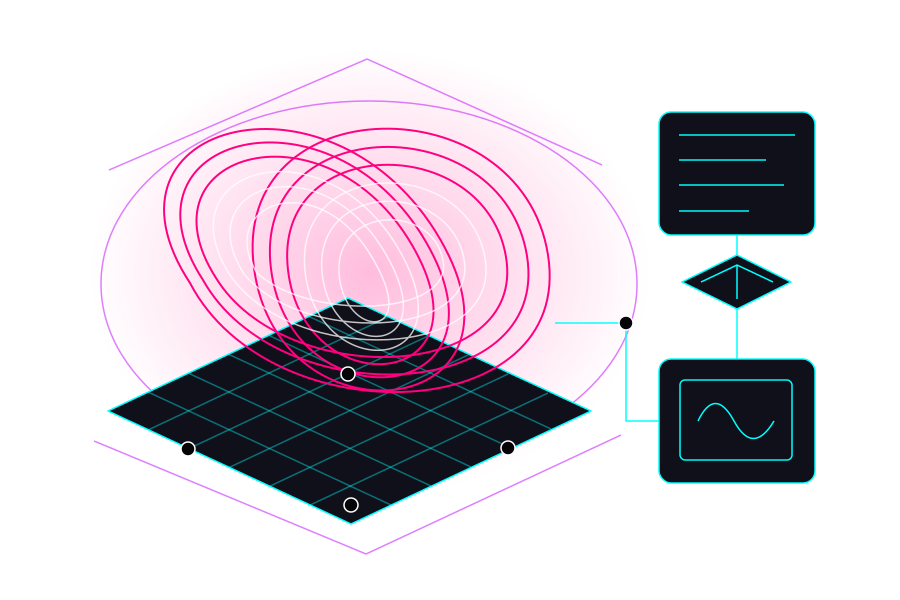
A numerical model and its visual representation
An illustrative intended journey, not a demonstration of the current live release.
- Choose SGPE-model parameters.
- Evolve the field in a computation worker.
- Transfer state through the data bridge.
- Compare the 3D presentation with model metrics.
System components
- Physics worker: numerical field evolution outside the UI thread.
- Data bridge: model-array representation and transfer.
- Three.js renderer: mapping data into a 3D scene.
- React controls and lifecycle hooks: worker, visualization and audio ownership.
Architecture & ownership
Computation, data transfer and rendering are separate. A rendering change is not a change to, or validation of, the numerical method.
How can numerical accuracy be tested independently of rendering quality and speed?
What to validate before use
Not experimental observation of macroscopic quantum coherence. FPS and allocation goals are not measured guarantees.
This describes the development scope. This page does not run the product, process payments or verify real-time availability.
Related products, distinct problems
- EvoSphere
Explore how local organism rules and environmental conditions change population behavior.
- The Algorithmic Universe
Study emergent structure as rules and parameters change, keeping mathematical ideas separate from observations.
- Phi · MATRIX-CORE
Separate an experiment from execution control while retaining its parameters and results.
- SRE · HAM
Test an alternative semantic-representation model through usable programming interfaces.
- Project Open Gate
Test whether a signal survives alternative explanations instead of turning a high score into a claim about reality.
- DVC · Project Apu
Preserve observation provenance and distinguish source objects from candidates, computed relationships and hypotheses.
Next step
Discuss a MQC Simulator workflow
Describe the problem, current system, constraints and desired outcome. We agree scope and deliverables before cost and launch.
Discuss the task on Telegram ↗The link opens a human contact; it does not send a message automatically.