SRE · HAM
Semantic Resonance Engine and Holographic Associative Memory: research into wave/tensor representations, search and associative retrieval.
Semantic memory and search · Python / Rust / TypeScript SDK / FastAPI / Semantic search
The product problem
Test an alternative semantic-representation model through usable programming interfaces.
A research engine with integration interfaces. Retrieval quality and scaling need reproducible comparisons.
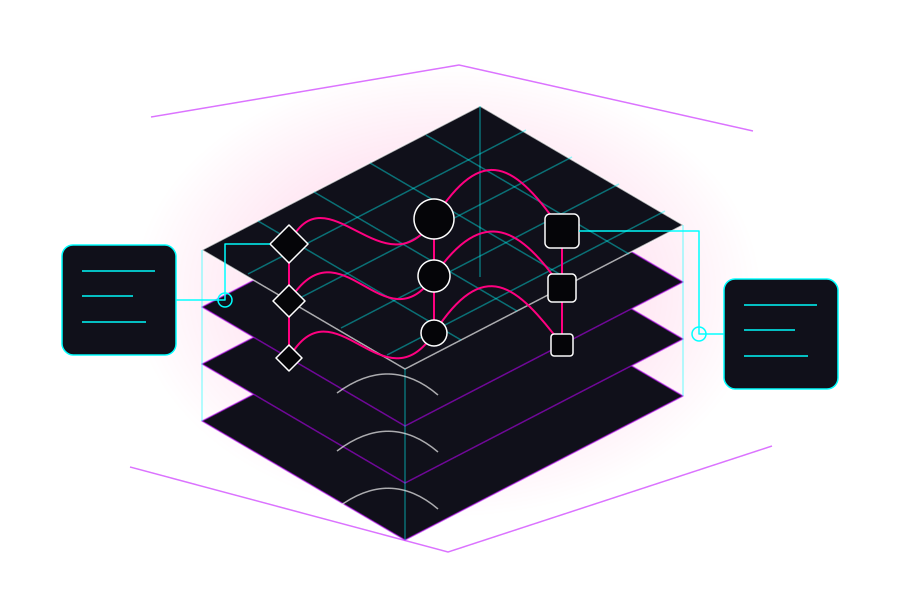
Record relations → search → retrieve
An illustrative intended journey, not a demonstration of the current live release.
- Represent data as semantic relations.
- Separate engine operations from memory storage.
- Call retrieval through an adapter or SDK.
- Compare results with quality references.
System components
- Engine model: representations and search operations.
- Store and associative memory: a separate write/retrieval layer.
- Server adapters: REST, a chat-completions-style interface and RESP.
- Python/TypeScript SDKs, experimental Rust modules and explicit QA groups.
Architecture & ownership
Core and store are distinct from server adapters and SDKs. RESP does not establish full Redis compatibility; Rust modules do not prove their use in every path.
How can an alternative representation be measured without calling it a universal search replacement?
What to validate before use
No ready database replacement, proven O(1), Zero-RAM, speedup or AGI claim is made.
This describes the development scope. This page does not run the product, process payments or verify real-time availability.
Related products, distinct problems
- EvoSphere
Explore how local organism rules and environmental conditions change population behavior.
- The Algorithmic Universe
Study emergent structure as rules and parameters change, keeping mathematical ideas separate from observations.
- MQC Simulator
Let users change model parameters and observe evolution without mixing numerical logic into the DOM interface.
- Phi · MATRIX-CORE
Separate an experiment from execution control while retaining its parameters and results.
- Project Open Gate
Test whether a signal survives alternative explanations instead of turning a high score into a claim about reality.
- DVC · Project Apu
Preserve observation provenance and distinguish source objects from candidates, computed relationships and hypotheses.
Next step
Discuss a SRE · HAM workflow
Describe the problem, current system, constraints and desired outcome. We agree scope and deliverables before cost and launch.
Discuss the task on Telegram ↗The link opens a human contact; it does not send a message automatically.